
New Hanover County Arrest Records
Arrest records in New Hanover County start with the agency action: an arrest, booking, arrest date, arresting or booking agency, and a charge description visible through sheriff channels when a person is in county custody. The Sheriff's Office public P2C system is the local path for inmate inquiry, daily bulletin entries, event search, and wanted-list information. It can show current booking information, but it is not the same as the complete court case file.
A court charge record is narrower than the full criminal case file. It focuses on the allegation filed after arrest or citation, including offense description, statute, charge class, warrant or citation number, arrest date, bond information, and first court date when those fields are public. The full criminal file can include pleas, motions, judgment, sentence, restitution, probation, fees, and appeals. For that broader outcome record, use New Hanover County criminal court records.
The Sheriff-to-Citizen portal is the county public-safety entry point for inmate inquiry, daily bulletin, most wanted, events, and FAQ tools.
P2C can help identify booking-side data, while Portal and clerk records show how formal court charges move through the case.
Search New Hanover County Charges
New Hanover County charge research should use both law-enforcement and court channels. Start with P2C if the person may be in custody or if the question is tied to an arrest event. Then search the NC eCourts Portal Smart Search by case number or name for the court case. For local paper files, copies, or public terminals, use the Clerk of Superior Court at the New Hanover County Courthouse. The clerk, not the county NextRequest portal, is the local custodian for court case files.
- Search P2C Inmate Inquiry for current booking charge, arrest date, and booking agency.
- Use Portal Smart Search by defendant name, case number, record number, or advanced filters where available.
- Open the court case and compare each filed charge with the booking charge or citation.
- Check hearing dates, courtroom, status, bond entries, disposition, and financial obligations.
- Contact the Clerk of Superior Court for missing files, certified copies, or public-terminal review.
P2C Inmate Inquiry is the current county jail roster source for booking-side arrest data.
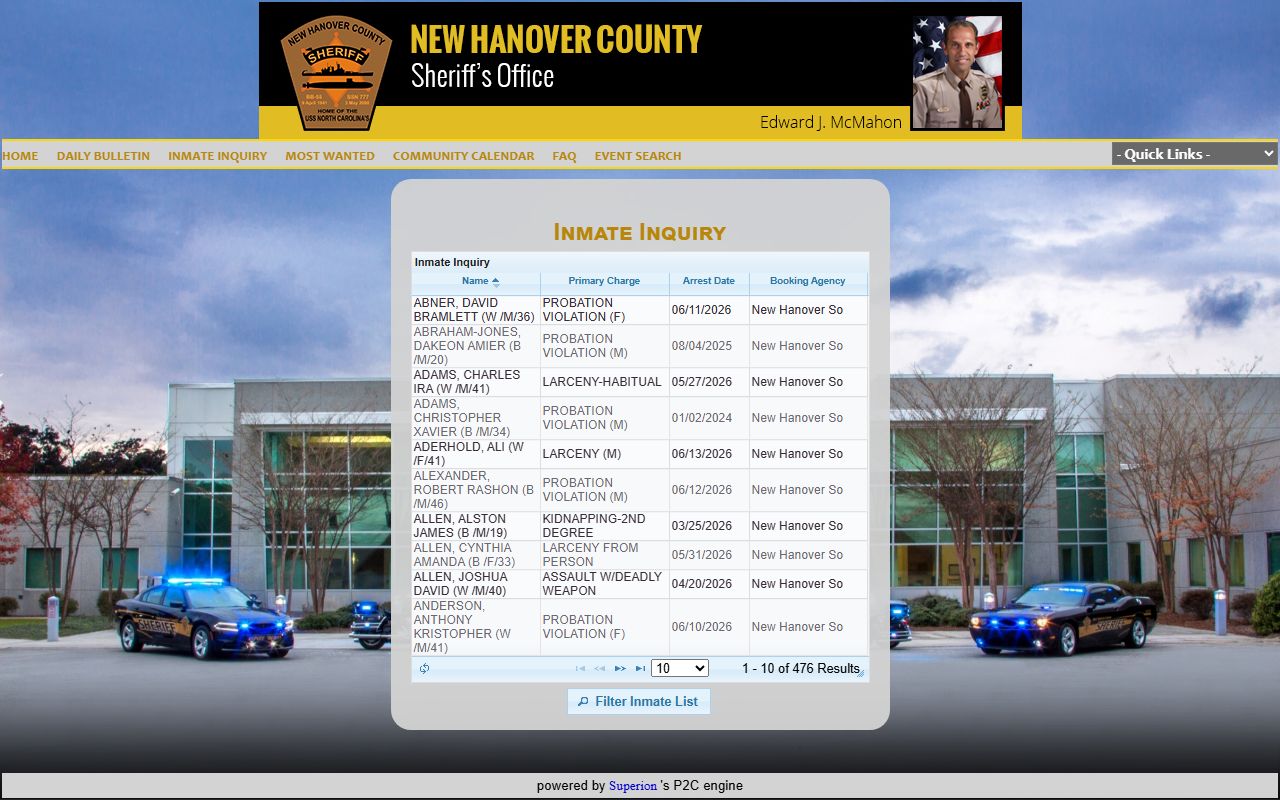
The jail roster can show the primary booking charge, but the court case controls later charge status and final disposition.
Charges After Arrest Documents
Charges after arrest can reach court through several documents. North Carolina court records may show a warrant, criminal summons, citation, indictment, information, statement of charges, or other charging event. Felony cases are handled in Superior Court. Misdemeanors and infractions begin in District Court, with appeals to Superior Court for trial de novo. Magistrates can issue criminal process and handle initial appearances.
| Document | Who Uses It | What It Does |
|---|---|---|
| Complaint or statement of charges | Officer, magistrate, or prosecutor path | States the alleged offense and starts or supports a criminal case. |
| Information | Prosecutor | Formal prosecutor charging document used where authorized. |
| Indictment | Grand jury | Formal felony charging document returned by a grand jury. |
The District Attorney for Prosecutorial District 6 prosecutes state criminal cases in New Hanover and Pender counties. The DA's office is at 316 Princess St in Wilmington and is led by Jason Smith. That office represents the State, prepares criminal trial dockets, and advises local law enforcement. The prosecutor can proceed with, amend, reduce, dismiss, or otherwise resolve filed charges based on law and evidence.
New Hanover County charge records can also reflect the court level where the case belongs. Felony charges move through Superior Court, while misdemeanors and infractions begin in District Court. A person may first see a short booking description in P2C, then later see a more formal offense label, statute reference, or case type in Portal. That difference does not always mean the wrong person or wrong case was found. Booking text is often brief, while the clerk record is built for case tracking, hearings, and final disposition.
New Hanover County Charge Status
Charge status can change after the first booking entry. A person may be arrested on one listed charge, then face an amended, reduced, added, dismissed, or indicted charge in court. The case record is the better source for the current status because it tracks hearing events, motions, pleas, dismissals, judgments, and sentence entries. P2C may remain useful for custody status and booking agency details.
| Status | What It Means | Where to Verify |
|---|---|---|
| Pending | The charge is still open and no final outcome appears. | Portal, hearing search, or clerk file. |
| Amended or reduced | The filed charge changed by prosecutor action, plea, or court order. | Case events and charging documents. |
| Dismissed | The charge was ended without conviction on that count. | Disposition field or judgment entry. |
| Not guilty | The person was found not guilty after the case was heard. | Disposition or judgment. |
| Convicted | A guilty plea or finding produced a conviction and sentence. | Judgment, sentence, and financial fields. |
The P2C FAQ explains jail-side questions such as visitation, charges, bonds, money, and wanted-list directions.
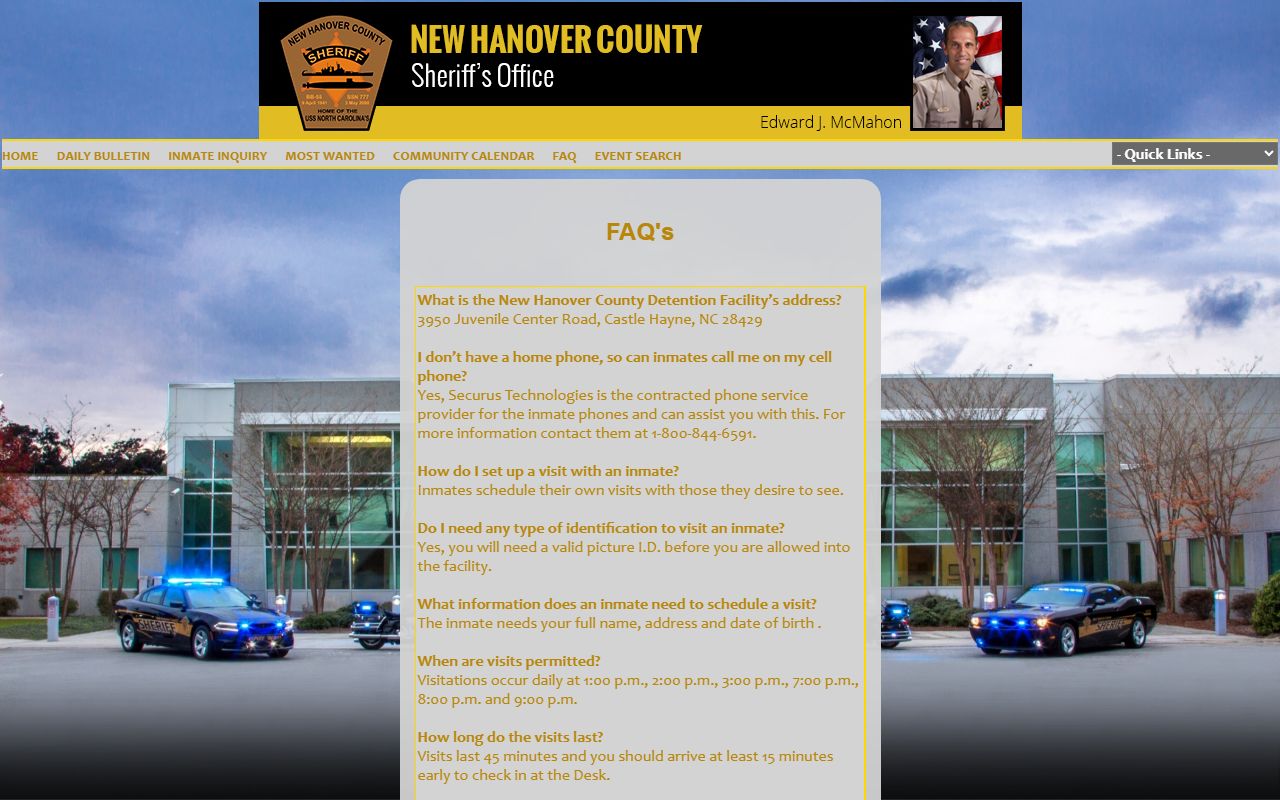
FAQ details are useful for custody and bond context, but court records remain the best source for charge disposition.
Charges vs Convictions
A charge is an accusation. A conviction is a final result after a guilty plea, verdict, or other court action that creates a guilty outcome. New Hanover County arrest records may show a booking charge before the court process has finished. Court records may later show that a charge was dismissed, reduced, amended, or resolved through a different count. Treat the words charge, disposition, judgment, and conviction as separate terms.
| Point | Charge | Conviction |
|---|---|---|
| Stage | Allegation after arrest, citation, summons, warrant, or indictment. | Final guilty result by plea or verdict. |
| Record source | P2C, Portal, charging document, clerk file. | Judgment, disposition, sentence, DMV report where applicable. |
| Can change | Yes, it may be amended, reduced, added, or dismissed. | Changes only by later court relief, appeal, or expunction. |
| Use caution | Do not treat a charge as proof of guilt. | Verify exact count and judgment before relying on it. |
Public records can be incomplete or delayed. Anonymous Portal views may omit protected case types or personal details. Public terminals and paper files at the Clerk of Superior Court may show more detail than online search, but restricted cases, sealed filings, juvenile matters, and expunged records are not public.
The most useful court-record fields for checking New Hanover County charges are case number, party name, filing date, case type, case status, court location, hearing date, courtroom, judicial officer, docket events, financial obligations, and disposition. Those fields help separate an open accusation from a resolved count. They also show whether the case has a bond hearing, probable cause hearing, arraignment, plea, trial date, dismissal, judgment, appeal, probation review, or compliance review.
Booking Events and Warrants
Some arrest-to-charge questions begin with a warrant, not a simple booking search. P2C Most Wanted can show wanted-list entries, and the sheriff's materials direct people to that section for warrant checks. A bench warrant or order for arrest may also appear in a court case after missed court, probation violation, or contempt. Portal may show failure-to-appear events, but it is not a complete active-warrant verification tool.
P2C Most Wanted is the sheriff public wanted-list source for warrant-related public entries.
Warrant entries can connect an arrest to later charges, but a no-result screen does not prove no warrant exists.
The P2C Daily Bulletin lists public sheriff events with case number, description, and officer fields.
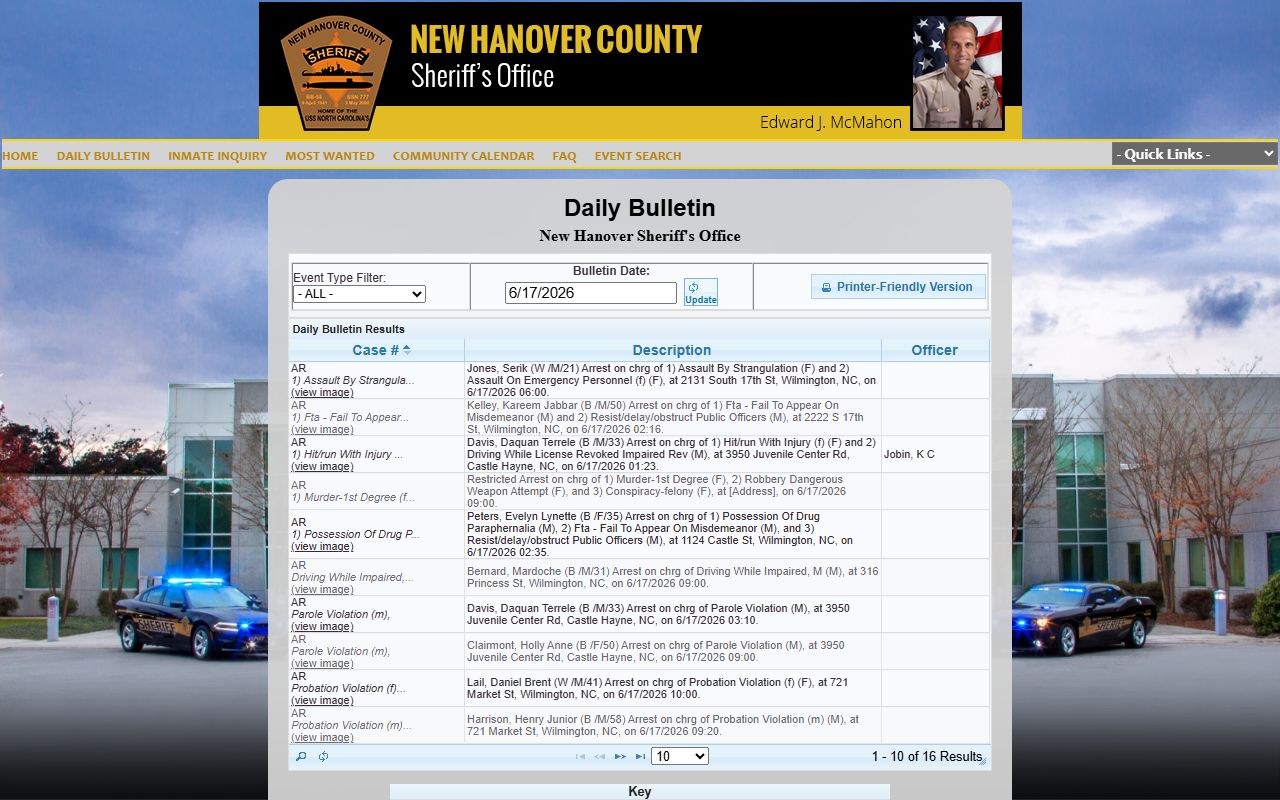
Daily bulletin entries can add law-enforcement context, while the formal court charge record still comes from the court system.
P2C Event Search allows event searches for up to a 180-day date range.
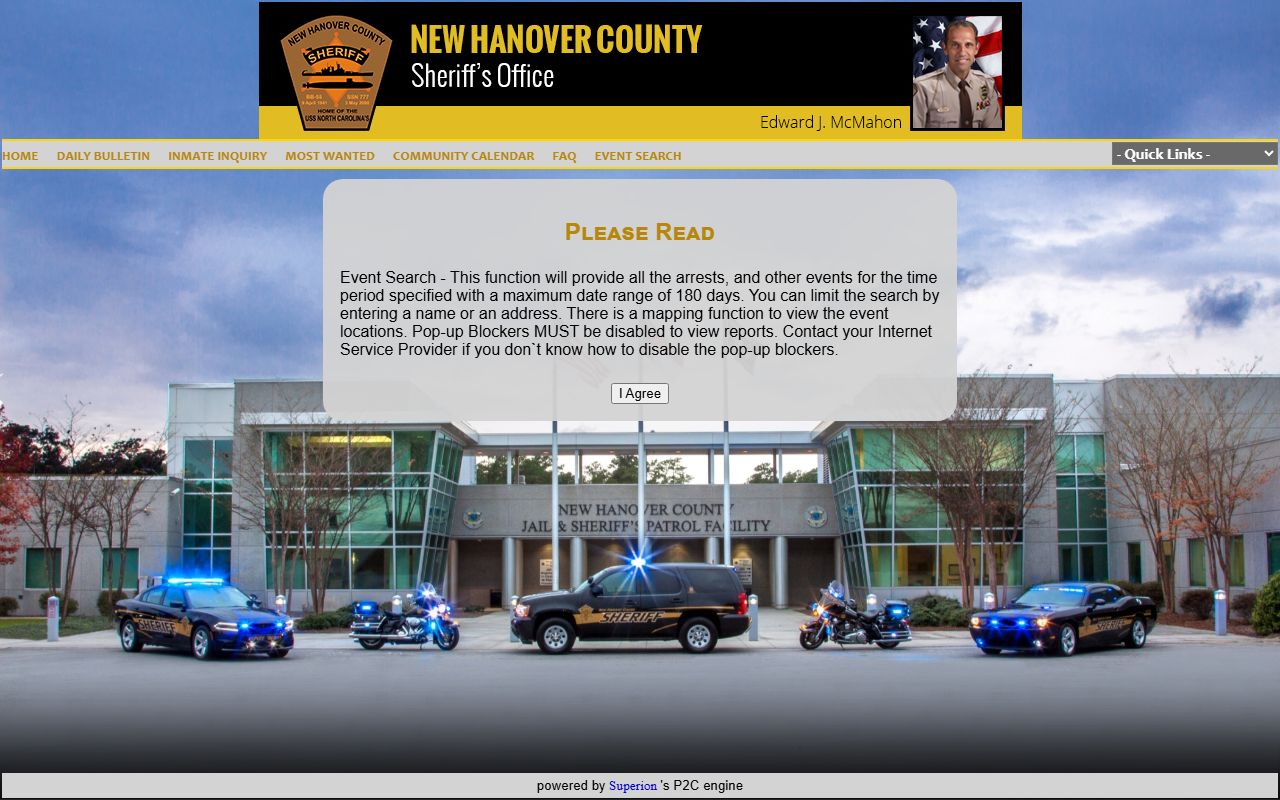
Event search can help locate recent law-enforcement activity, but it is not a certified court-charge record.
Restricted New Hanover County Charges
North Carolina public access is broad but not absolute. G.S. 132-1 defines public records broadly, while G.S. 132-1.4 limits criminal-investigation and criminal-intelligence records. Juvenile records are generally confidential under G.S. 7B-3000. Personal identifiers, financial account numbers, protected dates of birth, minor names, and sealed attachments may be redacted.
| Point | Sealed | Expunged |
|---|---|---|
| Public view | Hidden from routine public access by law or court order. | Cleared from public records for eligible matters. |
| Common basis | Safety, juvenile, mental health, investigation, or court order. | Eligible dismissal, not guilty result, or qualifying offense. |
| North Carolina law | Depends on case type and order. | G.S. 15A-145.5, G.S. 15A-146, and G.S. 15A-153 are key sources. |
Expunction is not automatic for every dismissed or old charge. A person seeking expunction usually starts with eligibility, selects the correct petition, files in the county of the charge or conviction, and waits for processing by the court, prosecutor, State Bureau of Investigation, and Administrative Office of the Courts where required.
For older or missing New Hanover County arrest records and charges, the fallback chain is local and specific. Use the Clerk of Superior Court for court filings, certified copies, and public terminals. Use the Sheriff's Office, P2C, or sheriff records channels for booking-side law-enforcement records. Use the NCAOC public-records form only for agency records held by NCAOC, because the research states that NCAOC is not the custodian of local court documents, case information, or vital records.
Note: Do not use arrest records or charge data for FCRA-regulated employment, tenant, credit, or insurance decisions.